Freedom awaits Walus, who’s still the biggest loser
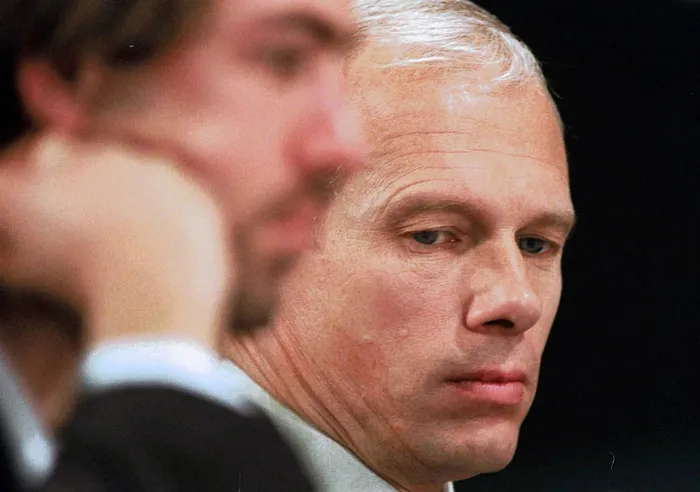
DONE HIS TIME: Janusz Walus. Picture: AP Photo/Joao Silva, File)
Janusz Walus is almost certainly going to be released this week, after nearly 30 years in prison for the 1993 assassination of Chris Hani.
He has been fighting for some time now to be set free, since he became legally eligible for parole 15 years ago.
But each court he approached over the years has denied his application, and justice ministers have found it far too controversial and politically sensitive to even consider it.
But the current minister, Ronald Lamola, will have no choice after the Constitutional Court unanimously ruled that it is time for Walus to be set free.
Understandably, many groups and individuals are outraged, not least of all Hani’s widow Limpho.
I had just started working as a journalist in Joburg when the struggle icon was shot dead in the driveway of his house in Boksburg, an East Rand suburb that has a very racist reputation, so assumptions were made almost immediately.

Socially, economically and politically, things were already extremely tense at the time.
The so called “Battle of Ventersdorp” was still fresh in everyone’s minds, AWB members participating in the invasion of Bophuthatswana had been gunned down in the streets a few weeks earlier, all while politicians from across the spectrum were trying to find common democratic ground at Codesa-II.
Many believed that we were teetering on the brink of a civil war and all we needed was one poorly-timed spark to ignite it all.
Walus’ bullet very nearly was that spark and we all remember that Nelson Mandela had to address the public with an emotional statement encouraging us to denounce the violence and instead stay the course.
So I understand the loathing for the Polish immigrant and the wish for him to die behind prison bars.
But I also understand that while he robbed us of one of our heroes, and how painful that is for us, ultimately, he failed in his attempt to derail Codesa which gave us the details of our democracy.
We can argue its value, but the fact is those details include a constitution and a rule of law that has proven itself to be one of the most resilient in the world.
The bitter irony is that Walus himself has used it to become a beneficiary of that rule of law.
But the very essence of an open democracy is that sometimes you are going to be on the side that celebrates its implementation, and sometimes you won’t.
We don’t have to like it, but we are forced to respect it.
At grassroots level it doesn’t seem fair; but within the bigger picture, there is a much greater, albeit counter-intuitive, justice being served requiring a deeper thinking.
You see, the justice (some might say vengeance) lies in the fact that while the individual, Walus, has won his freedom, the whole ideology behind his actions has lost its objective, especially since it results in his release. And that is worth celebrating.