John McCain, ex-POW, senator and political maverick, dies at 81
|Published
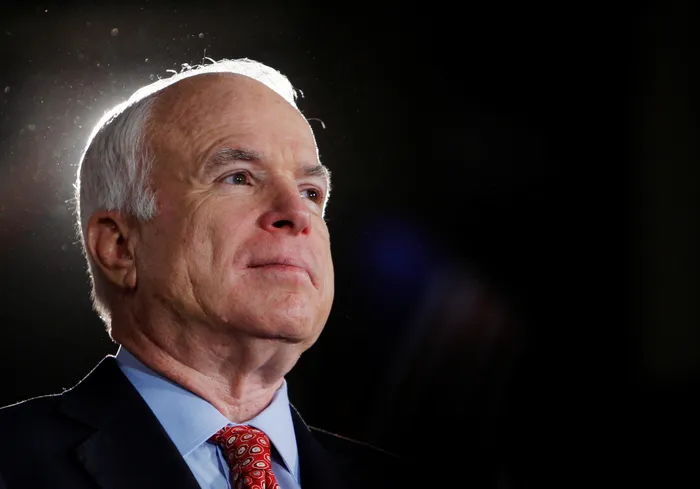
GONE: Senator John McCain. Photo: BRIAN SNYDER/REUTERS GONE: Senator John McCain. Photo: BRIAN SNYDER/REUTERS
U.S. Senator John McCain, a
former prisoner of war in Vietnam who ran unsuccessfully for
president as a self-styled maverick Republican in 2008 and
became a prominent critic of President Donald Trump, died on
Saturday, his office said. He was 81.
McCain, a U.S. senator from Arizona for more than three
decades, had been battling glioblastoma, an aggressive brain
cancer, since July 2017 and had not been at the U.S. Capitol in
2018. He also had surgery for an intestinal infection in April.
His family announced on Friday that McCain was discontinuing
further cancer treatment.
"Senator John Sidney McCain III died at 4:28 p.m. on August
25, 2018. With the senator when he passed were his wife Cindy
and their family. At his death, he had served the United States
of America faithfully for sixty years," a statement from his
office on Saturday.
McCain will lie in state in both Phoenix, Arizona, and in
the Capitol Rotunda in Washington, D.C., and will receive a full
dress funeral service at the Washington National Cathedral
before being buried in Annapolis, Maryland, his family said.
Former President Barack Obama, former President George W.
Bush and former Vice President Joe Biden were expected to give
eulogies.
Vice President Mike Pence was expected to represent the
current administration, the family said.
No further details were provided immediately.
"My heart is broken. I am so lucky to have lived the
adventure of loving this incredible man for 38 years," Cindy
McCain wrote on Twitter. "He passed the way he lived, on his own
terms, surrounded by the people he loved, in the place he loved
best."
AFFABLE. CANTANKEROUS
The vacancy created by McCain's death narrowed the number of
Republican-held seats in the 100-member U.S. Senate to 50 seats,
with Democrats controlling 49 seats in the upper chamber.
Republican Arizona Governor Doug Ducey was expected to appoint a
member of his own party to succeed McCain.
That could also give Republicans a slight edge in the battle
to confirm Brett Kavanaugh to the U.S. Supreme Court in the
weeks ahead because McCain had been too ill to cast any votes
this year.
Alternatively affable and cantankerous, McCain had been in
the public eye since the 1960s when, as a naval aviator, he was
shot down during the Vietnam War and tortured by his North
Vietnamese communist captors during 5-1/2 years as a prisoner.
He was edged out by George W. Bush for the Republican
presidential nomination in 2000 but became his party's White
House candidate eight years later. After gambling on political
neophyte Sarah Palin as his vice presidential running mate,
McCain lost in 2008 to Democrat Barack Obama, who became the
first black U.S. president.
Paying tribute to his one-time election opponent, Obama said
in a statement he and McCain, despite their "completely
different backgrounds" and political differences, shared "a
fidelity to something higher - the ideals for which generations
of Americans and immigrants alike have fought, marched and
sacrificed."
"We saw our political battles, even, as a privilege,
something noble, an opportunity to serve as stewards of those
high ideals at home, and to advance them around the world,"
Obama wrote.
Defense Secretary James Mattis saluted McCain as a figure
who "always put service to the nation before self," and
"represented what he believed, that 'a shared purpose does not
claim our identity - on the contrary - it enlarges your sense of
self'."
McCain, chairman of the Senate Armed Services Committee,
remained prominent during and after the last White House race as
both a frequent critic and target of his fellow Republican
Trump, who was elected president in November 2016.
McCain denounced Trump for, among other things, his praise
of Russian President Vladimir Putin and other leaders the
senator described as foreign "tyrants."
"Flattery secures his friendship, criticism his enmity,"
McCain said of Trump in his memoir, "The Restless Wave," which
was released in May.
McCain castigated Trump in July for his summit with Putin,
issuing a statement that called their joint news conference in
Helsinki "one of the most disgraceful performances by an
American president in memory." He said Trump was "not only
unable but unwilling to stand up to Putin."
Sources close to McCain have said Trump would not be invited
to the funeral.
Shortly after McCain's death was announced, Trump said on
Twitter: My deepest sympathies and respect go out to the family
of Senator John McCain."
THUMBS-DOWN
McCain, a foreign policy hawk with a traditional Republican
view of world affairs, was admired in both parties for
championing civility and compromise during an era of acrid
partisanship in U.S. politics. But he also had a famous temper
and rarely shied away from a fight. He had several with Trump.
He was the central figure in one of the most dramatic
moments in Congress of Trump's presidency when he returned to
Washington shortly after his brain cancer diagnosis for a
middle-of-the-night Senate vote in July 2017.
Still bearing a black eye and scar from surgery, McCain gave
a thumbs-down signal in a vote to scuttle a Trump-backed bill
that would have repealed the Obamacare healthcare law and
increased the number of Americans without health insurance by
millions.
Trump was furious about McCain's vote and frequently
referred to it at rallies, without mentioning McCain by name.
After Trump launched his presidential campaign in 2015,
McCain condemned his hard-line rhetoric on illegal immigration
and said Trump had "fired up the crazies." Trump retorted that
McCain was "not a war hero," adding: "I like people who weren't
captured."
After Trump became president, McCain blasted what he called
the president's attempts to undermine the free press and rule of
law and lamented the "half-baked, spurious nationalism" of the
Trump era.
MCCAIN VS OBAMA
McCain, the son and grandson of U.S. Navy admirals, was
elected to the U.S. House of Representatives from Arizona in
1982 after more than two decades of Navy service.
He served four years in the House before Arizona voters
elected him to the Senate in 1986 to replace Barry Goldwater,
the 1964 Republican presidential nominee revered by
conservatives.
In running for president in 2008, McCain tried to succeed an
unpopular fellow Republican in Bush, who was leaving office with
the United States mired in wars in Afghanistan and Iraq and
stuck in a financial crisis.
It was a stark contrast between McCain, then a 72-year-old
veteran of the Washington establishment, and the 47-year-old
Obama, who was offering a "Yes, we can" message of change.
McCain tried to inject some youth and enthusiasm into his
campaign with his selection of Palin, Alaska's governor, as his
running mate. But the choice backfired as her political
inexperience and shaky performances in media interviews raised
concerns about her qualifications.
McCain voiced regret in his new memoir for not choosing
then-Senator Joe Lieberman, a Democrat turned independent, as
his running mate.
McCain wrote that he had originally settled on Lieberman,
Democrat Al Gore's running mate in the 2000 election, but was
warned by Republican leaders that Lieberman's views on social
issues, including support for abortion rights, would "fatally
divide" the party.
"It was sound advice that I could reason for myself," McCain
wrote. "But my gut told me to ignore it and I wish I had."
Obama won 53 percent of the vote to McCain's 45.6 percent.
WAR INJURIES
McCain flew attack planes off aircraft carriers during the
Vietnam War. He was preparing for a bombing run in 1967 when a
missile inadvertently fired from another plane hit his fuel
tanks, triggering a fatal explosion and fire. He suffered
shrapnel wounds.
A few months later on Oct. 26, 1967, McCain's A-4 Skyhawk
was shot down on a bombing mission over North Vietnam's capital
and he suffered two broken arms and a broken leg in the crash. A
mob then dragged him from a lake, broke his shoulder and stabbed
him.
Held at the notorious "Hanoi Hilton" prison and other sites,
McCain was beaten and tortured, suffering broken bones and
dysentery. He was released on March 14, 1973, but was left with
permanent infirmities.
In Congress, McCain built a generally conservative record,
opposing abortion and advocating higher defense spending. He
supported Bush's 2003 invasion of Iraq and criticized Obama for
not doing more to intervene in Syria's civil war.
Still, he prided himself on his reputation as a maverick and
had a history of working across party lines on immigration,
climate change and campaign finance reform.
He also spoke out against the Bush administration's use of
waterboarding, a torture technique that simulates drowning, and
other harsh interrogation tactics on detainees in the aftermath
of the Sept. 11, 2001, attacks.
He urged the closure of the prison for foreign terrorism
suspects at the U.S. naval base at Guantanamo Bay, Cuba, and
also sponsored an anti-torture measure that passed Congress in
2005.
McCain wrote in a 2002 memoir: "I'm an independent-minded,
well-informed public servant to some. And to others, I'm a
self-styled, self-righteous maverick pain in the ass."
McCain was born on Aug. 29, 1936, at an American naval
installation in the Panama Canal Zone - U.S. territory at the
time - where his father was stationed.
He acknowledged he was a "smart ass" during his years at the
U.S. Naval Academy and graduated fifth from the bottom of his
class.
McCain divorced his wife Carol after 15 years of marriage in
1980 and weeks later married the former Cindy Henley, daughter
of a wealthy beer distributor in Arizona.
A dark period for McCain came as one of the "Keating Five"
group of senators accused of improperly intervening with federal
regulators to help political contributor and bank executive
Charles Keating, whose Lincoln Savings and Loan failed in 1989
at a cost to taxpayers of $3.4 billion.
McCain was cleared of wrongdoing in 1991 but the Senate
Ethics Committee rebuked him for poor judgment.
On July 25, 2017, McCain delivered a Senate floor speech not
long after his cancer diagnosis that was widely seen as his
farewell address. It included a call to fellow Republicans to
stand up to Trump and for all lawmakers to work together to keep
America as a "beacon of liberty" in the world.
"That is the cause that binds us and is so much more
powerful and worthy than the small differences that divide us,"
McCain said.