MIND OF A BABY SNATCHER

IN THE DOCK: Kidnapping accused Sameemah Jacobs
Image: Ayanda Ndamane
“THE baby is not seen as a person, but as a solution – something to fill a psychological void.”
This is the weigh-in of TEARS general manager of operations, Celeste Louw, as recent headlines centred around the kidnapping of nine-day-old baby Mogamat Imaad Sharmar in Cape Town last week.
And while the baba was returned to his mother unharmed two days later, the subsequent court case has the Cape community captivated.
Sameemah Jacobs of Tafelsig, Mitchells Plain made her first appearance at the Bellville Magistrates Court last Thursday where she is facing charges of kidnapping and defeating administrative justice and is expected back in court on 10 July for bail information.
In two recent cases at Gauteng hospitals, newborns were abducted and in both cases the babies were safely recovered thanks to CCTV surveillance and security measures.
According to Louw, the mind of a kidnapper is complex, in which they are faced with a psychological void to resolve.
She said: “The recent case of a newborn abducted from Bellville, Cape Town, has gripped the nation.
“Thankfully, the baby was recovered safely, due to swift community vigilance and police intervention.
“But the case has raised two pressing questions: Why do people kidnap children? And how often does it happen in South Africa?
“In this case the kidnapper appears to have acted out of emotional desperation, rather than criminal intent. Such cases, while rare, are deeply disturbing.
“They often involve a woman grappling with unresolved trauma: infertility, miscarriages, rejection, or the loss of a child. The baby is not seen as a person, but as a solution, something to fill a psychological void.”
Louw said that often, while the crime in being committed, the woman lives in a fantasy, convincing her mind that she is pregnant and even misleading loved ones.
She added: “The kidnapper convinces herself she is ‘rescuing’ the child or ‘deserving’ of motherhood.
"She may create an entire fantasy, may even fake a pregnancy, and then act when the pressure to produce a baby becomes unbearable.”
But Louw said no matter the reasons, a crime was being committed.
“There is no excuse for the damage caused to the birth mother, the fear endured by the child’s family, and the risk to the child’s safety,” she said.
"No amount of pain justifies taking someone else’s child. In terms of understanding why, the motivation comes more from a complicated mental health problem, a mixture of entitlement, emotional instability, and dissociation from reality.”
She said it was important to note that child kidnappings, both globally and in South Africa, were rarely emotionally driven.
She added: “Mostly, babies are stolen or fraudulently ‘placed’ with families, sometimes with falsified documents or the help of complicit insiders in clinics or hospitals.
“Despite the severity of the Bellville case, emotionally-driven baby snatchings remain statistically rare.
“They capture public attention because they often take place in ordinary setting, clinics, public spaces, communities, and involve individuals who don’t ‘fit the profile’ of a kidnapper.”
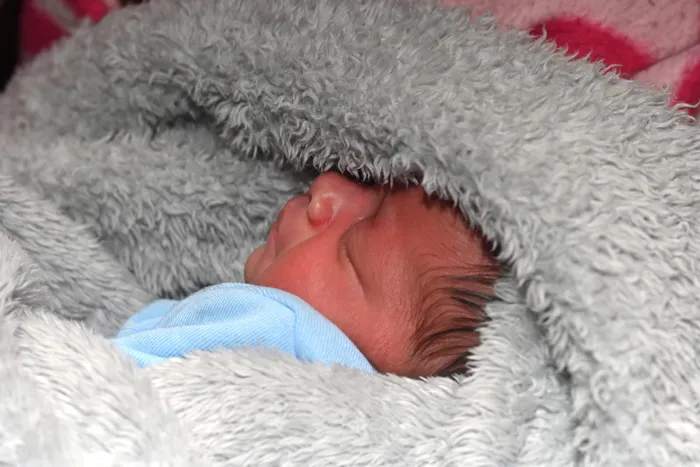
TAKEN AND RESCUED: Baby Mogamat Imaad Sharmar
Image: Ayanda Ndamane / Independent Newspapers